Archives for August 2012

MLA says call for potato boycott wasn’t intended to hurt producers as report show child farm fatalities on the rise

By Meghan Potkins, Calgary Herald August 24, 2012

A Liberal MLA who called for a boycott of Alberta potatoes over concerns that child labour remains unregulated in the province says he has no desire to damage the livelihoods of growers, while a report suggests safety risks are on the rise for Alberta farm children.

David Swann earlier this week called on snack-food giant Frito Lay, a subsidiary of PespiCo., to boycott Alberta potatoes in a bid to pressure the province to extend workplace health and safety regulations to farm workers.

PepsiCo. said it will continue to honour its contracts with growers, as a new report reveals an increasing risk to the safety of children on Alberta farms.

A report released earlier this month from the Alberta Centre for Injury Control & Research showed the rate of agriculture-related deaths among children increased an average of 5.8 per cent annually between 1992 and 2009.

While the overall number of children living on farms decreased by more than 50 per cent in the past two decades, the rate at which children were killed on farms over the same period has increased.

A total of 69 children and youths were killed over the 18-year period, the majority of them between the ages of 5 and 9 years old.

A majority of the deaths were the result of a child being run over by a piece of farm equipment, typically tractors.

Drownings were the second most common manner of death.

Nearly twice as many children suffered major agriculture-related traumatic injuries over a shorter period — approximately 132 children were admitted to hospital with serious injuries between 1996 and 2009.

The statistics gathered by the centre do not indicate if the children were labourers or residents of the farm, or the type of farm where the incident occurred.

But the report’s authors suggest that the majority of fatalities involved children living on a farm who were not necessarily paid labourers.

Kathy Belton, co-chair of ACICR, said many farm deaths are preventable and that steps can be taken to make farms safer for children and adults.

Belton said an expansion of the province’s occupational health and safety laws to include agriculture workers is “essential” to making farms safer.

She said farming deaths and injuries must be investigated in the same way as other workplace incidents.

“If it’s an industrial (death), there is a full-blown investigation,” Belton said. “If it’s a farm death — if a farmer is out there digging an irrigation ditch and he dies — there is no investigation because there is no legislation.”

“We need to look at farming differently in this province.”

A spokesperson for the province said the ministers of agriculture and human services will discuss the report when they meet next month.

“Our government believes that education and awareness are still the most effective way to deal with the practical realities of Alberta farming. Minister Hancock has indicated that the government is looking at all aspects of agri-business and agri-industry to determine if we have the right regulations, or whether we need to change regulations with respect to worker safety, worker compensation or other occupational health and safety standards,” Cathy Housdorff, a spokesperson for the department of agriculture, said in an e-mail.

“The two ministers will be discussing the report as well as other items when they meet next month.”

In an open letter to producers, Swann said the point of the boycott was not to hurt growers but to pressure the government.

The Calgary MLA admits he received complaints from farmers about the boycott.

“I’m not trying to damage our agriculture industry. I’m trying to get the attention of government,” he said.

There were 16 agriculture-related deaths in 2011. Two were children, according to the province.

[email protected]

© Copyright (c) The Calgary Herald

From the Lethbridge Herald

Redford Government Announces Moving Forward with “Bold” and “Ambitious” Land Use Plans – Bill 36

If you have not already heard, this week the Redford Government announced that it is moving forward with Bill 36.

The Cabinet released its new Regional Plan for north-east Alberta.  This is the first of seven regional plans that will be approved by Cabinet.

 We had hoped that the government was rethinking its approach to imposing Cabinet-controlled central planning but it is not—full speed ahead for Bill 36.

The final regulations for the new Regional Plan say that Cabinet Ministers must order their bureaucrats to prepare management plans for any landowner or business that is not meeting the new social, environmental, and economic “targets” and “limits” set by the Cabinet.  (Regulation sections 11, 26 and 33)

 These sections also say that you must comply with the lawful directions of the bureaucrats.

This first Regional Plan may not have a large impact on landowners and ranchers because most of the land in the north-east part of our province is Crown land.

 It will be a completely different impact when the Redford Government rolls out its next Regional Plan—the one for the South Saskatchewan River basin.  Almost all of the land in that region is either private land or Crown land under grazing leases.  Irrigators will also be impacted.  The Cabinet can use its powers to rescind water licences, feedlot approvals, grazing leases, development rights and every other form of statutory consent that southern Albertans rely on  to keep their businesses, farms and the economy going.

 The big oil companies that have had their Crown leases rescinded (torn up) by the Cabinet under the new Regional Plan regulation are now trying to get compensation from the government.  Remember that Bill 36 strips you of your right to compensation—and right to appeal to the Courts.  You now need to seek an audience with the Minister, plead your case for compensation and are at the mercy of the Cabinet.  Prior to Bill 36, Alberta law prevented the government from rescinding your water licences, grazing leases, and other statutory consents.  When the government did have the power of rescission, there were binding obligations to pay fair compensation.  Not anymore under the PC government.  They control everything now and your rights are gone.

Soon we will get to see what the Cabinet’s plan is for southern Alberta.  Soon all landowners will be under the thumb—and the whims—of the Cabinet Ministers and their bureaucrats.  Central planning is here.  Respect for property rights, the rule of law and our market driven economy are gone.  We now officially live in a European-style nanny state.

_________________________

 Canadian Property Rights Conference 2012

Leading experts on property rights will be speaking at a conference in Ottawa on September 14 to 16.

The Alberta Landowners Council’s policy chair, lawyer Keith Wilson, is one of the invited speakers.  We are proud of all he has done for landowners in Alberta, and it is obvious that others also want to hear what one of Alberta’s most influential people has to say. (voted by Alberta Venture Magazine as one of Alberta’s most influential people)

If you are interested in attending the conference, further information and registration details can be found at this link:  http://propertyrightscanada.org/index.php/speakers

SNC’s choice of anglophone may upset Quebecers but please investors: analysts

Monday, 13 August 2012 18:01 Ross Marowits, The Canadian Press

MONTREAL – SNC-Lavalin’s choice of an experienced American executive to head the Quebec-based engineering giant will be well-received by the beleaguered company’s investors, despite some political concerns in the province that he doesn’t speak French, analysts said Monday.

Robert Card, a senior executive at CH2M Hill Companies and former undersecretary of energy in the U.S., will take the reins Oct. 1.

He was chosen after a global search for leaders outside the Montreal-based company, which has recently been mired in scandal.

Former CEO Pierre Duhaime stepped down in March amid controversy over millions in mysterious payments in North Africa.

Card and his family plan to move to Montreal and learn French, but the naming of an anglophone to head one of the province’s marquee businesses is sure to upset some Quebecers in the midst of a provincial election campaign.

Concerns have been raised about a hostile bid to acquire Quebec’s hardware giant Rona (TSX:RON) by U.S. retailer Lowe’s.

There were also some grumblings when bilingual Ontario-born Michael Sabia was chosen to head the Caisse de depot fund manager – despite his long-time Quebec residency – and when unilingual George Cope was picked to head Montreal-based BCE, while he lives in Toronto.

Parti Quebecois leader Pauline Marois said Monday that SNC should require Card to take French lessons so that at least he becomes bilingual.

SNC-Lavalin (TSX:SNC) spokeswoman Leslie Quinton said the ideal candidate to head “this great Quebec institution” would speak French.

“However, at a time when the company requires strong, decisive and insightful leadership, the most important criterion was to hire the best overall candidate with significant international experience,” she said in an email.

Quinton added that the company has a global reach and that attracting someone with such extensive experience demonstrates that Montreal is an attractive international location to which such people can be recruited.

Analyst Frederick Bastien of Raymond James said Card’s appointment may not be initially well-received by the average Quebecois who expected another francophone to head the firm.

“But we are of the view that SNC shareholders should be pleased that the firm has managed to attract someone with Mr. Card’s experience and reputation,” he wrote in a report.

In a report, the Vancouver-based analyst said the SNC-Lavalin board’s key focus was to identify an experienced senior leader with both an extensive background in the international engineering and construction sector and a deep understanding of the complexities of operating internationally.

“At first blush it would seem SNC accomplished just that.”

Card served as president of CH2M Hill’s energy, water and facilities division and earlier headed its government, environment and nuclear division.

Privately-held CH2M Hill is a Fortune 500 engineering firm with 30,000 employees in more than 80 countries and $6 billion of revenues. It has competed against SNC-Lavalin for many contracts.

Analyst Maxim Sytchev of Alta Corp Capital said investors will be pleased that SNC’s board selected an outsider to help instill a perception of a clean start to re-establish investor confidence in the company.

He said Card’s U.S. government pedigree will prove invaluable to help SNC expand its presence south of the border, where it is running two private-public partnership projects. Only 3.4 per cent of SNC’s total corporate revenues are derived from the U.S.

“Clearly having somebody who was the undersecretary of the department of energy, I’m sure that he’s got a pretty nice Rolodex to delve into,” Sytchev said in an interview.

He expects Card will eventually guide SNC to expand its U.S. footprint, especially in private-public partnerships. Card’s first focus is to ensure governance changes are appropriate before deciding if any changes are required in about six months, he said.

Sytchev dismissed any concerns about Card’s inability to speak French, saying SNC is a global firm.

“The company and the board of directors answer to the shareholders, not to anybody else.”

Pierre Lacroix of Desjardins Capital Markets said the appointment of an outsider will bring “fresh eyes” to the company’s management and governance practices.

“While we view the appointment of a new president and CEO as a positive catalyst for the shares, we believe the market reaction should be gradual until Mr. Card elaborates on his strategic vision for SNC,” he wrote in a report.

Card and board chairman Gwyn Morgan declined requests for interviews until the new CEO assumes his duties.

On the Toronto Stock Exchange, SNC’s shares closed at $37.28, down 22 cents in Monday trading.

National Energy Board wants company’s internal report on Michigan spill

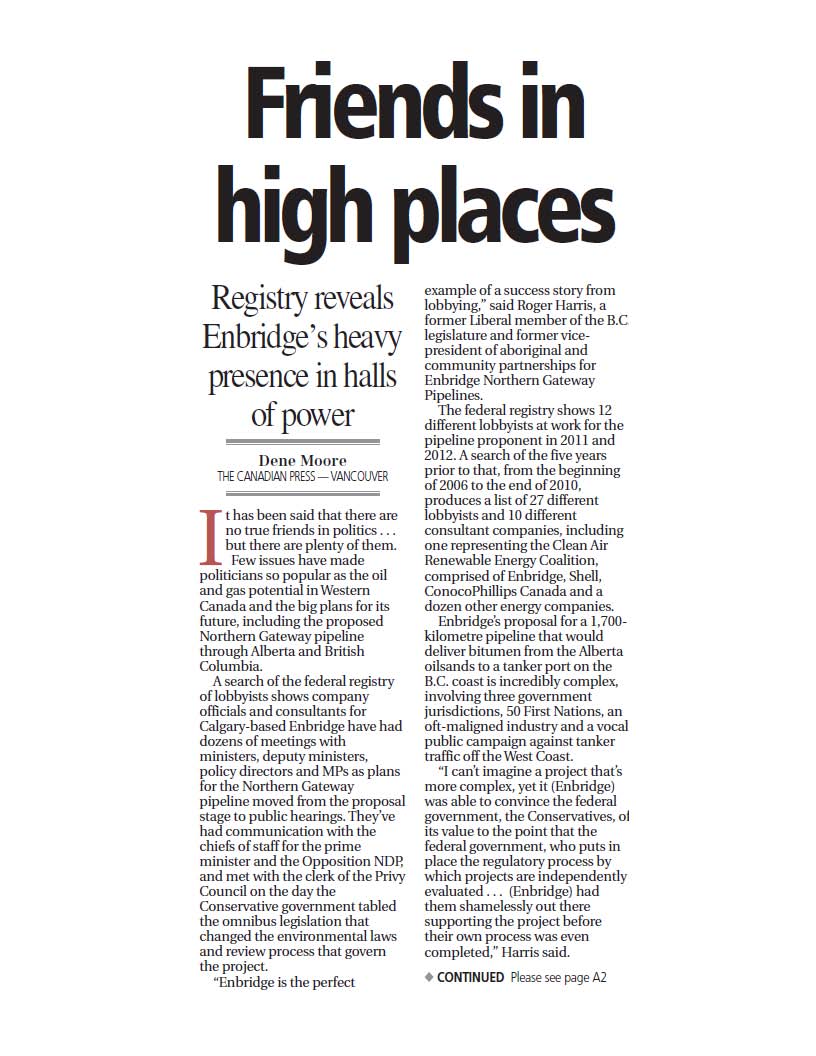
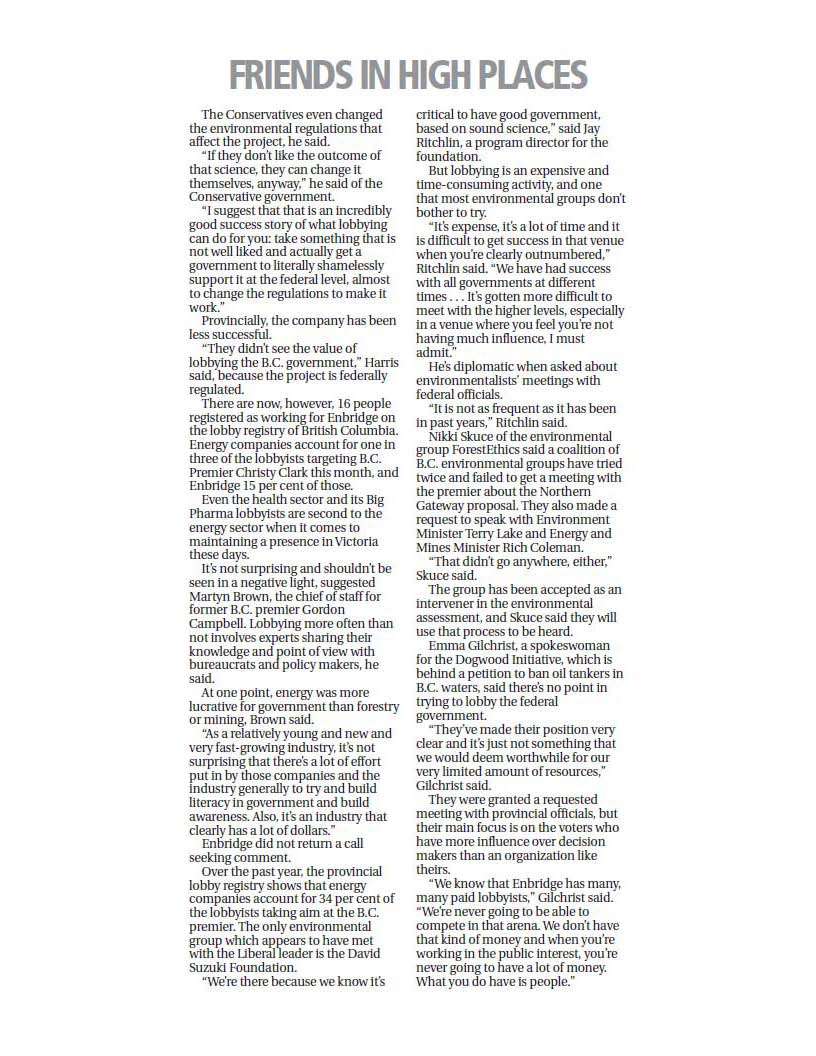
Friday, 17 August 2012 19:10 Dene Moore and Vivian Luk, The Canadian Press

VANCOUVER – The National Energy Board has asked Calgary-based Enbridge (TSX:ENB) to provide documentation of improvements it has made since a massive oil spill in Marshall, Michigan two years ago.

Board inspectors visited the company’s control centre in Edmonton a week ago as part of an increase in inspections the board announced following a damning report by U.S. authorities on the spill in the Kalamazoo River in July 2010.

In a letter sent Friday, the board asked for a copy of Enbridge’s internal investigation into the pipeline rupture and documentation of the corrective actions it has taken.

The board also wants to know what improvements have been made to the company’s in-line inspection program since the incident and it wants a copy of the control room management plan.

The investigation by the U.S. National Transportation Safety Board found a litany of errors in Enbridge’s control centre that led to a spill of more than 20,000 barrels of oil into the Kalamazoo River.

According to the report, a segment of Line 6B ruptured during the final stages of a scheduled pipeline shutdown on July 25, 2010.

Even though multiple alarms were set off at the control centre in Edmonton, staff believed it was because of a change in pressure due to the shutdown and not because of a rupture. After the 10-hour shutdown was finished, pipeline operations resumed.

“Leak-detection alarms were generated, but Enbridge staff continued to believe the alarms were the result of column separation, even though the Marshall area was relatively flat, without significant changes,” the report said.

More than 17 hours after the rupture, a gas utility worker finally notified the Enbridge control centre about oil on the ground.

The U.S. report concluded that, among other things, deficiencies in Enbridge’s pipeline integrity and inadequate training of control centre personnel were to blame for the spill that affected more than 50 kilometres of waterways and wetlands and cost $800 million to clean up.

Since the Michigan spill, Enbridge says it has made multiple improvements to its pipeline integrity management, leak detection and control centre operations.

In an email sent to The Canadian Press last month, Northern Gateway President John Carruthers said Enbridge has now doubled the number of employees and contractors to detect leaks, added more control centre staff, improved training and technical support, and opened up a new control centre in Edmonton.

The oil giant has “revised and enhanced all procedures pertaining to decision making, handling pipeline startups and shutdowns, leak detection system alarms, communication protocols, and suspected column separations,” the email says.

The company’s proposed Northern Gateway pipeline from the Alberta oil sands to a tanker port on the B.C. coast is currently under review by a federal environmental assessment panel.

Opposition blasts ‘troubling’ hiring of defeated Alberta Tory Evan Berger

By James Wood, Calgary Herald August 18, 2012

Opposition parties stepped up their attacks on the appointment of a defeated Tory cabinet minister to a senior civil service post while members of the Progressive Conservative government remained silent on the issue Friday.

The Wildrose Party said the hiring of former agriculture minister Evan Berger as senior policy adviser to the deputy minister of agriculture raised serious questions about the impartiality of the office of the ethics commissioner.

Berger’s appointment had to be scrutinized by ethics commissioner Neil Wilkinson because there is a one-year restriction on former cabinet ministers receiving a contract or benefit from a department with which they had “significant official dealings” during their final year in cabinet, according to conflict of interest legislation.

Wilkinson granted an exemption for Berger’s hiring, which is allowed under the act.

“It’s so troubling the ethics commissioner waived a blatant conflict. That’s why that rule is there, to stop that exact thing from happening,” said Wildrose MLA Rob Anderson.

“You can’t have a politician get kicked out of office and then be hired back by his department a couple months later. It’s just beyond belief, frankly.”

The Wildrose, Liberals and NDP all called Friday for an explanation of the ethics commissioner’s decision to grant an exemption.

Wilkinson, a former chairman of the Capital Health Region board, was not available for comment.

Glen Resler, chief administrative officer in the commissioner’s office, said the appointment was approved under a clause in the legislation that allows an exemption if it is demonstrated the activity “will not create a conflict between a private interest of the former minister and the public interest.”

“In this instance there is that direct employment relationship with the department, he is working directly with agriculture, a lot of the subject matter is the thing he was working on before … he definitely has the qualifications as the candidate,” he said.

The employment contract was also scrutinized and conditions were set by the ethics commissioner.

© Copyright (c) The Calgary Herald

Former DFO officer says Stephen Harper ‘disembowelled’ science behind Enbridge pipeline

By Dene Moore, The Canadian Press August 19, 2012

VANCOUVER – While Prime Minister Stephen Harper says the fate of Enbridge’s proposed pipeline from the Alberta oilsands to tankers on the British Columbia coast will be based on science and not politics, documents show some of that science isn’t forthcoming.

And critics say there is no time for the science to be completed before a federal deadline for the environmental assessment currently underway.

Documents filed with the National Energy Board show the environmental review panel studying the Northern Gateway project asked Fisheries and Oceans Canada for risk assessments for the bodies of water the proposed pipeline will cross. The pipeline is to traverse nearly 1,000 streams and rivers in the upper Fraser, Skeena and Kitimat watersheds.

The department didn’t have them.

“As DFO has not conducted a complete review of all proposed crossings, we are unable to submit a comprehensive list as requested; however, this work will continue and, should the project be approved, our review will continue into the regulatory permitting phase,” DFO wrote in a five-page letter dated June 6, 2012.

The response went on to say there “may be differences of opinion” between the company and the department on the risk posed by the pipeline at some crossings. It provided two examples of crossings of tributaries to the Kitimat River where Enbridge rated the risk as low but Fisheries rated it medium to high.

DFO said the federal ministry will continue to work with the company to determine the risk level and level of mitigation required.

“DFO is of the view that the risk posed by the project to fish and fish habitat can be managed through appropriate mitigation and compensation measures,” said the department’s response.

“Under the current regulatory regime, DFO will ensure that prior to any regulatory approvals, the appropriate mitigation measures to protect fish and fish habitat will be based on the final risk assessment rating that will be determined by DFO.”

Earlier this month, Harper told reporters in Vancouver that “decisions on these kinds of projects are made through an independent evaluation conducted by scientists into the economic costs and risks that are associated with the project, and that’s how we conduct our business.”

He went on to say “the only way that government can handle controversial projects of this manner is to ensure that things are evaluated on an independent basis, scientifically, and not simply on political criteria.”

But the federal government recently sent letters to 92 habitat staff members within Fisheries and Oceans in B.C., telling them that their positions will be cut. Thirty-two of them will be laid off outright.

The cuts will mean the department in B.C. has half the habitat staff it had a decade ago.

All but five of the province’s fisheries field offices will be cut as part of a $79 million — 5.8 per cent — cut to the department’s operational budget, including the offices in Prince George and Smithers that would have had the lead in monitoring pipeline effects.

The marine contaminant group that would have been involved in a spill in B.C. has been disbanded and the fisheries and environmental legislation gutted, said Otto Langer, a retired fisheries department scientist.

“He (Harper) says the science will make the decision. Well he’s basically disembowelled the science,” said Langer. “It’s a cruel hoax that they’re pulling over on the public.”

Former federal Liberal fisheries minister David Anderson agrees.

Given the Dec. 31, 2013, deadline set by the federal government, Anderson said scientists in the Fisheries Department simply don’t have time to complete any substantial scientific study of the project.

“You can’t do these studies on the spur of the moment. It takes time to do them,” Anderson said. “And the federal Fisheries have just been subjected to the most remarkable cuts, so you’re in the throes of reorganization and reassessment and re-assigning people, and on top of it you throw them a major, major request for resources and work.

“It can’t be done.”

The department has three major projects in B.C. currently undergoing federal environmental assessment: Northern Gateway, a massive hydroelectric project called the Site C dam, and a gold-copper mine near Williams Lake, B.C., that was previously rejected following a federal environmental review.

Dr. Steve Hrudey, who was chairman of the Royal Society of Canada’s expert panel on the environmental impact of the oil sands two years ago, said it is normal for the company asking for environmental approval — in this case Enbridge — to provide the information in question in the review process.

“They have to foot the bill,” said Hrudey, who was also involved in more than two dozen reviews over 17 years as a member and then chairman of the Alberta Environmental Appeals board.

The project proponent pays consultants to prepare studies and reports required by the review board, the relevent federal departments look at those reports, respond with questions and comments of their own, and the panel then goes back to the proponent with those questions and requests for further information.

There may be several cycles of this back-and-forth.

“In the end DFO will say ‘No, it’s what we think it is and therefore you have to take measures we feel are appropriate for that rating,'” Hrudey said.

But if the department’s ability to do the studies itself is questionable, some scientists fear the process will unfold without independent scientific study.

“It (the response from Fisheries to the panel) implies that the request to the joint review panel will not be answerable until after a decision has been made, until after the project has been approved,” said Jeffrey Hutchings, a marine biologist at Dalhousie University.

“This seems, from a science perspective, a rather indefensible position in so far as a key part of the environmental review process is to evaluate the degree to which the pipeline will affect fish habitat.”

A spokesperson for the panel said there has been no further request for information from DFO, and no further information is expected.

The federal department said a spokesperson was not available for an interview, but provided a statement via email saying Fisheries is providing advice to the assessment panel on the potential impacts of the project on fish and fish habitat.

“Fisheries and Oceans Canada has provided its assessment and is of the view that the risk posed by the project to fish and fish habitat in the freshwater and marine environments can be managed by the proponent through appropriate mitigation and compensation measures,” said the email, which echoed the response sent to the panel.

“The Department notes in its submission that the proponent has conducted a reasonable ecological risk assessment and provided useful information on the risks that an oil spill (in either marine or freshwater) would pose to fisheries resources.”

Hutchings found it odd that they’re so sure.

“Well, how can you make that judgment when you have not yet conducted a complete review of all proposed crossings?” he said. “Again, from a science perspective, I don’t see how it’s possible to be able to draw that conclusion.”

The proposed Northern Gateway is a $6-billion project expected to spur $270 billion in economic growth in Canada over 30 years.

Rat patrol steps up war on hundreds of rodents at Medicine Hat landfill

By Sherri Zickefoose, Calgary Herald August 17, 2012 6:43 AM

Hundreds of rats infesting a Medicine Hat landfill have provincial officials scrambling to defend Alberta’s rat-free status.

More than 50 rats have been caught and killed at Medicine Hat’s garbage dump since the colony was discovered last week.

Single Norway rat sightings were first reported in the area last spring, officials say.

“We’re going to estimate that this infestation is small rather than large, and by small we mean several hundred rats as opposed to thousands,” said Vaughn Christensen, manager with Alberta Agriculture and Rural Development.

”And we do have it isolated and contained.”

The infestation is “one of our larger ones,” since the rat eradication program began in 1952, Christensen said.

“Occasionally, we get small investigations around the border.”

Agriculture Minister Verlyn Olson vowed to resolve the issue.

“We’re up to 52 now, and they’ve been destroyed,” Cypress County agricultural fieldman Jason Storch said Thursday.

Workers are monitoring the site around the clock with infrared digital cameras and bait traps loaded with poisoned food and water. Neighbouring homes and farms have also been outfitted with poisonous traps to prevent the spread of pests.

If needed, bull snakes may be let loose at the landfill.

A single pair of healthy rodents are capable of breeding 15,000 young in a year.

“It’s very hard to tell how many are in there. There’s no way of knowing. But we’re making headway at this point,” said Storch.

“We’re just monitoring it and that’s going to continue until they’re all gone,” he said.

Dozens of bait stations are set up about every three metres around the landfill.

“We’re doing more perimeter baiting to keep ahead on everything. The trick here is to get ahead of them.”

Alberta claims to be rat-free, and has only experienced isolated cases of the rodents since the 1950s.

The province, which spends $350,000 a year on its rat-control program, has 11 rat inspectors who patrol the border with Saskatchewan, aiming to prevent the vermin from destroying crops.

Six counties and municipal districts participate in the patrol of the rat-control zone, which is 30 kilometres wide and stretches 390 kilometres from the Montana border to Cold Lake.

Despite the efforts, rodents carried by shipping containers on airplanes, trucks and trains, and some bought by pet owners as snake food, show up in Alberta frequently, officials say.

The City of Calgary fields about 200 rat calls each year, but almost all turn out to be squirrels, muskrats or gophers.

In 2011, four pet rats were discovered in Calgary. Last year, the city located five Norway rats. One came dead in a truck, and the other four were categorized as pets, or fancy rats.

City officials issued a warning that it is illegal to keep rats as pets after three Norway rats were seized from two homes last February.

Possession of a rat can lead to a fine of up to $5,000.

Norway rats can measure up to 25 centimetres long and weigh around half a kilogram.

Provincial law requires that rats discovered in Alberta either be euthanized or removed from the province.

[email protected]

© Copyright (c) The Calgary Herald

Defeated Tory cabinet minister Berger gets plum civil service job

By James Wood, Calgary Herald August 17, 2012 5:27 AM

A defeated Tory cabinet minister is going back on the Alberta government payroll in an appointment the Wildrose Opposition says raises big concerns over Progressive Conservative cronyism and the politicization of the civil service.Evan Berger, who was agriculture minister before losing his Livingstone-Macleod riding in the spring provincial election, was offered a contract Thursday as senior policy adviser to deputy minister of agriculture John Knapp.

Knapp said he was solely responsible for hiring Berger to the civil service post based out of Lethbridge — which pays in a range between $120,158 and $157,910, plus pension and benefits — and there was no involvement by any elected members of the Progressive Conservative government.

There was no posting or open competition for the job because Berger had the “exact skill set” needed, he said.

“Where it’s clear given the criteria you’re looking for — in other words the deep policy knowledge, the experience, the ability to integrate issues in a way that clearly Mr. Berger has demonstrated in the past — holding a competition wastes public dollars, wastes time and effort, and is highly inefficient,” said Knapp, who served as Berger’s top public service official when he was in cabinet.

Berger — who was first elected in 2008 and was appointed to cabinet by Premier Alison Redford last October — said he doubted there would be much public concern over his appointment because of his qualifications. He said he will be dealing with many of the agricultural programs he helped initiate in government. Berger said he will retain his PC membership and likely remain politically active.

“I would think I would probably still be around different things,” said Berger, who added he may run again for his old seat in the next election.

“Four years is a long ways out. I’ve said to people if the support is there and people are looking, I’m willing.”

Berger lost to Pat Stier in the Wildrose Party’s near sweep of rural southern Alberta.

According to an estimate by the Canadian Taxpayers Federation’s Scott Hennig, Berger would have been eligible for around $147,000 under the transition allowance available for defeated and retiring MLAs.

Berger said he has not touched the allowance, but it remains available to him in the future.

Wildrose MLA Shayne Saskiw scoffed at the idea there was no political role in Berger’s hiring.

“This completely demonstrates Premier Redford’s inability to change the PC party at all. It’s the same-old, same-old culture of entitlement. Here we have an individual that lost an election and because he’s a friend of the PCs he’s getting a lucrative contract in the six figures,” he said. “It seems like another PC at the taxpayer trough.”

Tory Agriculture Minister Verlyn Olson was not made available to comment. His press secretary, Cathy Housdorff, said Olson did not have a role in the hiring, but had no problem with Berger’s appointment.

The appointment needed the approval of the province’s ethics commissioner.

Former ministers face a one-year period where they are forbidden to “solicit or accept a contract or benefit from a department of the public service or a provincial agency with which the former minister had significant official dealings” during their final year in cabinet, according to conflict of interest legislation.

The ethics commissioner can, however, waive that cooling-off period, which Knapp said had been done.

“I’m absolutely confident both the hire was appropriate and the process behind the hire was fair, transparent, above board and clearly had the green light from the ethics commissioner,” said Knapp.

[email protected]

© Copyright (c) The Calgary Herald

Original source article: Defeated Tory cabinet minister Berger gets plum civil service job

Enbridge stirs up controversy with depiction of West Coast waterway as containing no islands

Critics say video an attempt to mislead public

By Judith Lavoie, Times Colonist August 15, 2012

About 1,000 square kilometres of islands have disappeared from Douglas Channel in an animated depiction of Enbridge Inc.’s proposed Northern Gateway pipeline and tanker route.

The project would send bitumen by pipeline from Alberta’s oilsands to Kitimat, where it would be loaded onto tankers for export to Asia.

A video on the Enbridge website shows Douglas Channel as a wide open funnel leading from Kitimat to the Pacific, omitting the narrow channels, islands and rocky outcrops that make up the potential tanker access route.

The view of Douglas Channel sprang to public attention after Lori Waters, a Vancouver Island researcher and owner of a biomedical communications company, created overlays and maps showing the real Douglas Channel and posted the images on Facebook.

Reaction against Enbridge – which is fighting an image problem because of recent pipeline spills – was swift.

“I find the pictures shocking. It’s reprehensible behaviour,” said University of Victoria climate scientist Andrew Weaver.

“These images are disturbing enough to make me no longer trust anything coming from Enbridge. It’s utterly shameful,” he said.

However, Enbridge said the video is an obvious animation and contains a disclaimer that says it is “broadly representational.”

“That video is meant to be for illustrative purposes only. It’s not meant to be to scale. It’s meant to illustrate the pipeline route, not the marine aspects of the operation,” said Enbridge spokesman Todd Nogier.

“There’s a disclaimer at the end because it’s really clear this is meant to be illustrative,” he said.

The video is meant to be pleasing to the eye, but viewers would not mistake it for a detailed map, Nogier said.

A tanker safety video showing Douglas Channel in detail and to scale, together with technical reports on every aspect of the marine route, are on the Enbridge website, he said.

“If they are trying to conclude that we are trying to mislead people, nothing could be further from the truth. There’s lots of information there. It’s all there and it’s all for public viewing,” Nogier said.

However, groups opposed to the proposed pipeline and tanker project believe the video is an attempt to mislead.

The Enbridge view of Douglas Channel would make anyone who knows the area chuckle, said Eric Swanson of the Dogwood Initiative.

“In reality, it’s a twisting path through rocky islands and granite outcroppings, including 90 degree turns, but it’s shown as a sparkly, open channel,” he said.

“They are certainly painting a rosy picture of a very complicated and dangerous waterway.”

The video fits with recent Enbridge advertising campaigns, Swanson said.

“It’s more hyper-positive imagery because they know they have a problem because of the spills,” he said.

Josh Paterson, a staff lawyer with West Coast Environmental Law, said the promotional video skirts the line on fair advertising.

“That image really misrepresents the reality, which is that that channel is jam-packed with islands,” Paterson said.

“You are really not supposed to omit big pieces of information like that and

British Columbians should look at the images and decide how far they are willing to trust the company, regardless of what disclaimer they put on the video, Paterson said.

“A comparison of their images with the actual really raises questions about the trustworthiness of what they are telling people in B.C.,” he said.

[email protected]

© Copyright (c) The Victoria Times Colonist

Original source article: Enbridge stirs up controversy with depiction of West Coast waterway as containing no islands